

2 hr
Te Puia Geothermal Valley Tour with Traditional Haka Performance
Explore bubbling geysers and witness an authentic Māori cultural show in Rotorua's geothermal heartland
Reserve

Steam rises from Whakarewarewa, voices rise from the wharenui.
Hand-picked by our editors — only the best 5 experiences from 60 reviewed.
Verified partners for every tour, free cancellation where available, and instant confirmation on every booking.
2 hr
Explore bubbling geysers and witness an authentic Māori cultural show in Rotorua's geothermal heartland
Reserve
2 hr 30 min
Immerse yourself in authentic Māori traditions with ceremonial performances, geothermal wonders, and earth-oven cuisine
Reserve
3 hr 30 min
Authentic indigenous gathering featuring storytelling, ceremonial performance, and chef-prepared feast in forest setting
ReservePrices from verified partners. Availability updates in real time at checkout. Free cancellation policies apply where shown.
The landmarks, rooms, and views travelers on this tour remember — all visible on a single visit.
The largest active geyser in the southern hemisphere, often erupting up to 30 meters high. It provides a natural backdrop for the geothermal valley site.
They complement each other; visitors seeking geothermal landscapes and daylight history prefer Te Puia, while those desiring an evening forest atmosphere choose Mitai Māori Village. Selecting the right rotorua haka show tours depends on whether you prioritize geological activity or a nocturnal cultural performance.
| Feature | Top pick Te Puia | Mitai Māori Village |
|---|---|---|
Time of Day |
Daylight | Evening |
Primary Focus |
Geothermal and Arts | Warrior traditions and history |
Geothermal Access |
Active geysers and mud pools | None |
Cultural Immersion Style |
Museum and workshop based | Forest-based performance |
Setting |
Valley and park grounds | Private forest and riverbank |
| See tickets → |
Verdict: Choose Te Puia if you want to combine your rotorua haka show tour with exploration of New Zealand’s geothermal landscapes, or book Mitai Māori Village for a focused, evening-only cultural experience.
Choose your ticket, select your date, and reserve in under two minutes. Secure checkout handled by our verified partner.
Instant confirmation by email, with a mobile voucher you can save offline. No printing, no queuing at a collection desk.
Arrive at the entrance, show your voucher on your phone, and walk in. Most tickets include priority or skip-the-line access.
Best time to go, insider tips, nearby landmarks, and the cancellation fine print — flip through to skim what matters to you.
How crowds, weather, and events shift across the year.
December to February offers warm weather ideal for outdoor walking tours and viewing geysers in sunlight.
March to May provides milder temperatures and fewer crowds compared to peak summer months.
June to August brings cooler air, perfect for seeing steam rise from geothermal vents against a crisp backdrop.
September to November features blooming native flora and consistent daylight hours for full exploration.
Small details that turn a good visit into a great one.
Purchase rotorua haka show tickets online to secure your preferred tour time.
Rotorua weather changes quickly; be prepared for geothermal humidity and cool breezes.
Listen carefully to the guide during your rotorua haka show tour for protocol details.
For safety in the thermal valley, never leave marked walkways.
The best arrival window is 09:00–16:00 to avoid late-day closures.
Non-bookable sights within a short walk — free to visit, easy to pair.
The largest active geyser in the southern hemisphere erupting frequently.
A geothermal basin featuring bubbling mud pools and silica terraces.
Educational facility training local artisans in traditional carving and weaving.
Flexible, no hidden fees.
Cancellations made within 24 hours of the booking time are generally non-refundable. Please refer to your specific booking confirmation for refund eligibility regarding the 76 NZD entrance fee.
Hand-picked options within walking distance — pick a district for vibe, or a specific hotel for convenience.
Hotel located near the geothermal zone.
Convenient access to city center and Te Puia.
Wide selection of motels and hotels near major amenities.
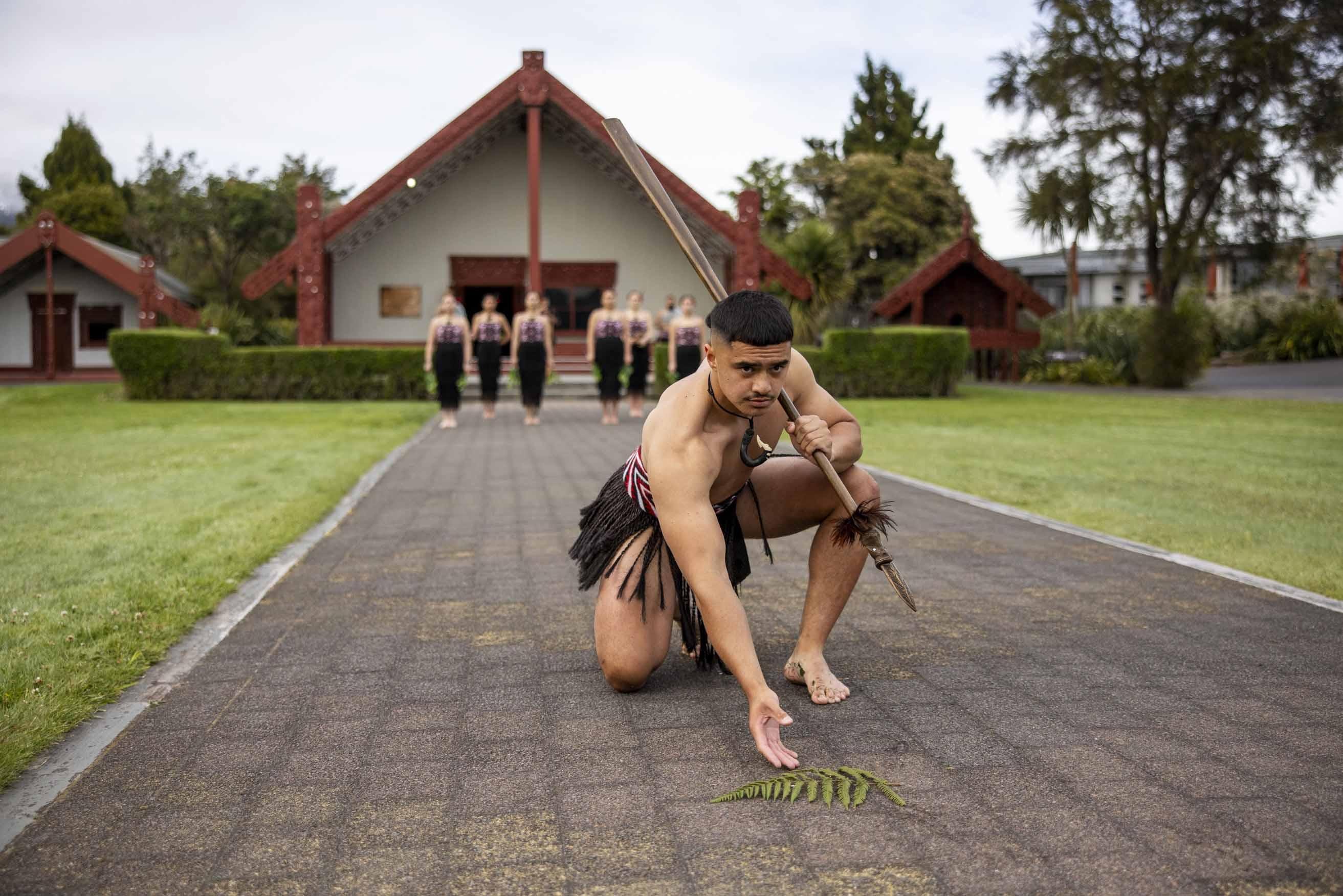
Pōhutu erupts up to twenty times a day, throwing water thirty metres above the Whakarewarewa terraces — and it has never been switched off, ticketed as a spectacle, or scheduled to suit an audience. Te Puia grew up around that indifference. Cooking pools, bathing pools and steam vents were infrastructure long before they were attractions. The cultural performance that visitors now book as a rotorua haka show is not a recent invention layered over the geology. Kapa haka — the disciplined art of posture dance, waiata and haka — has been performed on this ground continuously, and the guided experiences that carry visitors through it are structured around living practice rather than reconstruction. The New Zealand Māori Arts and Crafts Institute was established here by an Act of Parliament in 1963, and it remains the reason the site matters beyond its geysers. Its carving school, Te Wānanga Whakairo, and its weaving school, Te Rito, train a small intake of students each year in whakairo and raranga. Those students are not exhibits. They are apprentices in an unbroken transmission, and the carved poupou around the site are their examinable work. The architecture rewards slow attention. Te Aronui a Rua, the meeting house, anchors the marae complex where visitors are welcomed with a pōwhiri, the formal challenge and greeting that precedes any performance. Around it sit the mud pools, the silica terraces, and the kiwi conservation enclosure that houses the national bird in low light. Te Puia's Māori cultural tours read the valley as a single text: geothermal, artistic and genealogical at once. Context explains why rotorua haka show tours here differ from a stage act elsewhere. The performers are largely local, the reo is spoken rather than recited, and the whakapapa connecting the group to the ground beneath the stage is stated openly at the start. Rotorua's geothermal landmarks are its obvious draw. This one is also a school, a marae and a workshop, which is a rarer combination than the steam suggests.
"The carvers here are not exhibits; they are apprentices in an unbroken transmission."
Booking rotorua haka show tickets online in advance is the most efficient way to ensure entry.
Personal photography is allowed, though please remain respectful during the rotorua haka show performance.
The rotorua haka show is family-friendly and open to visitors of all ages.
Cancellations made within 24 hours of your rotorua haka show tour may be subject to non-refundable fees.
Visitors can easily combine the rotorua haka show with a visit to the adjacent Pōhutu Geyser.